Medical Disclaimer
  • For Educational Purposes Only: This content is intended for educational reference and should not be used for clinical decision-making.
  • Not a Substitute for Professional Judgment: Always consult your local protocols, institutional guidelines, and supervising physicians.
  • Verify Before Acting: Users are responsible for verifying information through authoritative sources before any clinical application.
AI Assistance Notice
The clinical content and references are curated and reviewed by myself; however, AI was used to assist in organizing, paraphrasing, and formatting the information presented.

Bedside Topline (What to Remember in a Crisis)

How Impella Works
Impella heart pump animation showing mechanism of action
Device Overview & Options

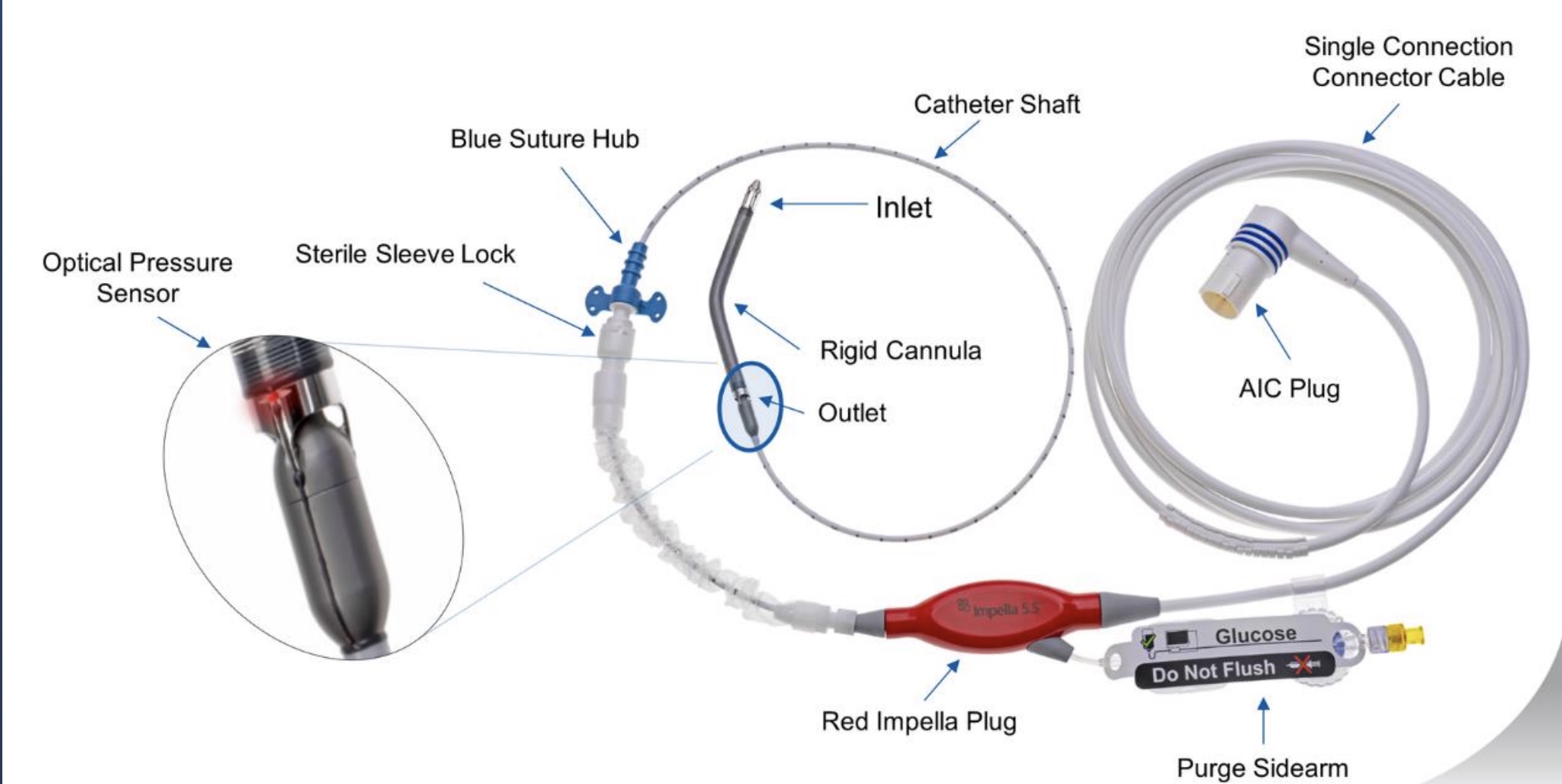
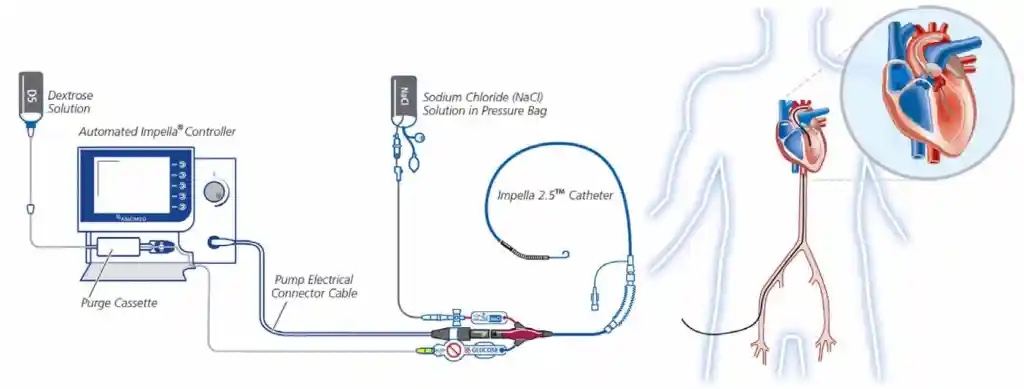
Impella is a short-term, catheter-based ventricular assist device. A microaxial pump sits across the aortic valve, drawing blood from the mid–left ventricle and ejecting it into the ascending aorta. This provides forward flow while directly unloading the LV.

Swipe to see more
Device Typical Route Approx Max Support Use Case
Impella 2.5 Femoral arterial ~2.5 L/min Smaller patients, high-risk PCI, modest LV support
Impella CP Femoral or axillary arterial ~3.5–4.0 L/min Most common ED/ICU device for AMI cardiogenic shock
Impella 5.0 Surgically placed (axillary/femoral graft) ~5.0 L/min More durable, higher flow; bridge in severe LV failure
Impella 5.5 Surgical (axillary) ~5.5–6.0 L/min "Surgical LVAD-lite" for days–weeks of full LV support
Impella RP Femoral venous → RA → RV → PA ~4.0 L/min Acute RV failure (post-MI, post-cardiotomy, LVAD patients)
Remember: All devices require meticulous vascular access management, continuous anticoagulation (unless contraindicated), and close monitoring for hemolysis and limb ischemia.
Mechanism & Core Physiology

How the Impella Changes the LV's Job

  • Pump inlet sits 3–5 cm below the aortic annulus in the LV cavity; outlet sits in the ascending aorta
  • The impeller provides near-continuous flow from LV → aorta, so the LV no longer has to generate the full aortic pressure and forward stroke volume
  • LV pressure–volume loop shifts down and left: ↓ LVEDV, ↓ LVEDP, ↓ wall tension (Laplace), ↓ myocardial O₂ demand
  • By moving the operating point to a more favorable part of the Frank–Starling curve, the remaining LV contractility is used more efficiently

Systemic Hemodynamic Effects

  • ↑ MAP and ↑ forward flow (device flow + native LV output) → ↑ systemic and coronary perfusion
  • ↓ LVEDP and LV wall stress → ↓ subendocardial ischemia, potential for myocardial recovery
  • ↓ Pulmonary capillary wedge pressure → ↓ pulmonary edema and improved gas exchange
  • Afterload sensitivity: high SVR or hypertension ↓ Impella forward flow and can increase LV work despite the device

Right Heart Interplay

  • Impella depends on adequate RV output and preload: RV failure → underfilled LV → suction alarms + low flows
  • Unloading LV and improving forward flow can lower pulmonary venous pressures and indirectly affect RV afterload
  • In BiV failure, aggressive LV unloading can increase venous return to a weak RV and worsen RV congestion; watch CVP, PAPi, and RV function closely
Clinical Pearl: The Impella is sensitive to loading conditions. Think of it as a "low-profile LVAD" that needs the right preload and afterload to work optimally.
Console Basics, Flows & Waveforms

Key Console Parameters

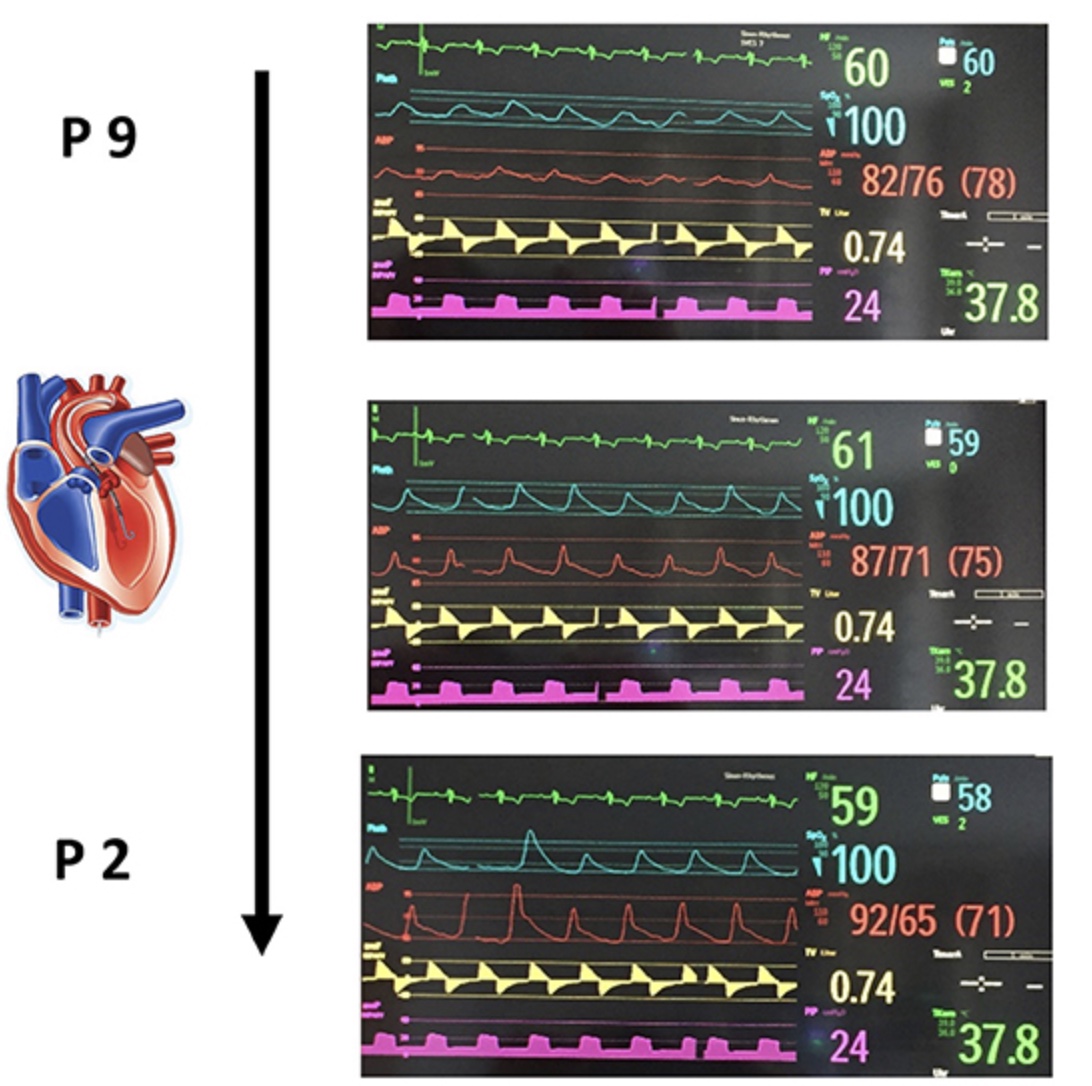
  • P-level: power setting (roughly correlates with pump speed and flow). Never go below P2 except during explant/weaning per protocol
  • Flow (L/min): estimated device flow; will drop with high afterload, suction events, or motor dysfunction
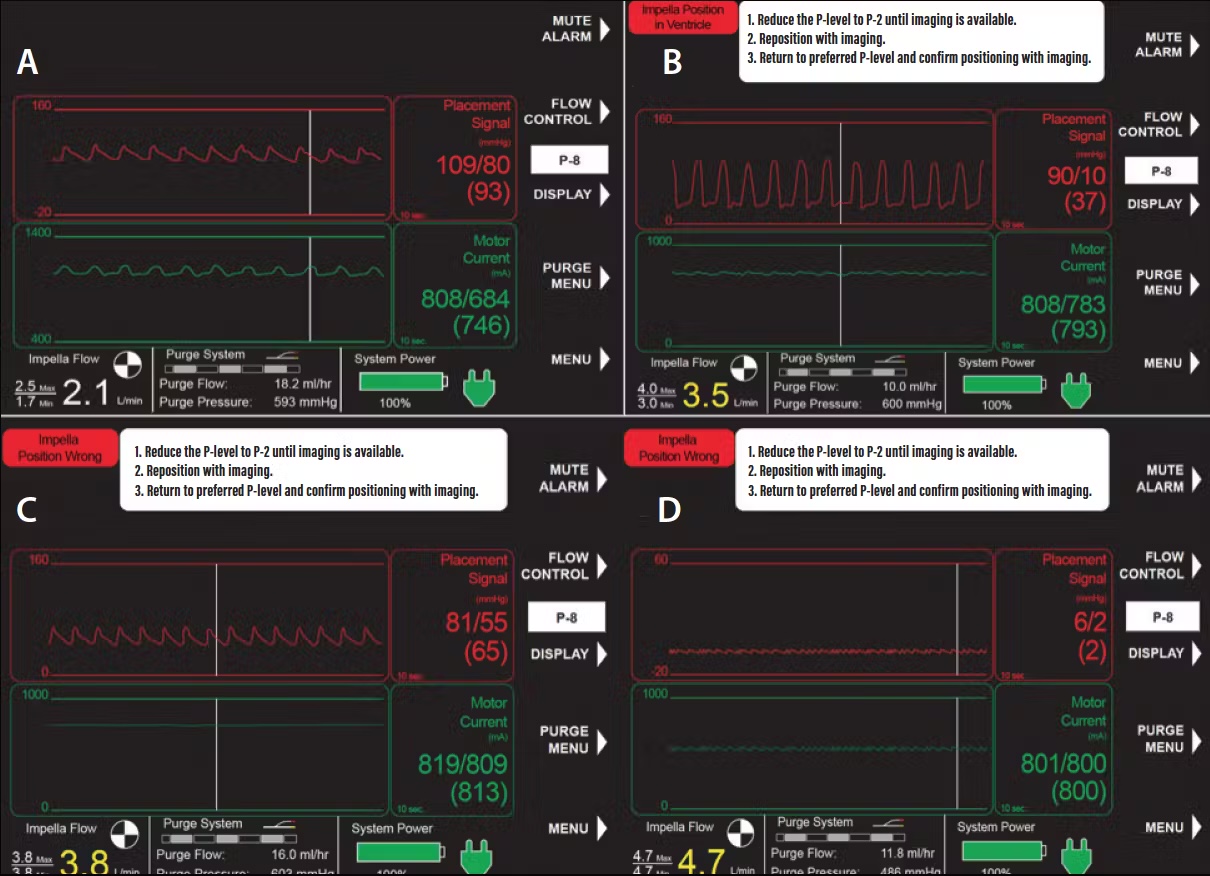
  • Motor current (green waveform): should be pulsatile; loss of pulsatility implies poor LV contraction or malposition
  • Placement signal (red): approximates aortic pressure waveform near the outlet
  • LV pressure (white): approximates pressure near the inlet; used to recognize suction

Practical Bedside Interpretation

  • Good scenario: pulsatile motor current, clear aortic-looking red waveform, LV pressure showing reasonable diastolic pressure, stable flow at target P-level
  • Bad scenario: non-pulsatile motor current, LV pressure deeply negative in diastole, low flow despite high P-level → think suction or malposition
Critical Warning: Loss of pulsatility on motor current is a red flag. Check device position with echo and assess LV function.
Hemodynamic Targets & Monitoring

Use Impella numbers together with an arterial line, right heart catheter (if present), labs, and echo.

Swipe to see more
Parameter Target Why It Matters
MAP ≥60–65 mmHg Ensure perfusion without choking device with afterload
CI >2.0–2.2 L/min/m² Adequate global forward flow with device + native LV
CPO ≥0.6 W Integrates pressure and flow; low CPO = undersupported shock
CVP <10–15 mmHg High = RV failure/volume overload; low may indicate underfilling
PCWP ~10–15 mmHg Enough preload to avoid suction, low enough to avoid pulmonary edema
PAPi >~1 PAPi <1 suggests significant RV dysfunction
SvO₂ >50–60% Low value suggests DO₂ still inadequate or high demand

Routine Monitoring Bundle

  • CBC: Hgb for hemolysis or bleeding, platelets for thrombocytopenia
  • Hemolysis labs: plasma free Hgb, urinalysis for hemoglobin, LDH/bilirubin trend
  • Coagulation: anti-Xa or ACT/aPTT per protocol
  • End-organ perfusion: lactate, creatinine/UOP, transaminases
  • Daily or targeted echo to confirm device position and assess LV/RV function
Indications & Contraindications

Common Indications for LV Impella

  • Acute myocardial infarction (especially STEMI) with cardiogenic shock despite optimal medical therapy and revascularization
  • High-risk PCI with poor LV function, large territory at risk, or anticipated hemodynamic instability
  • Acute decompensated chronic heart failure with low-output shock where recovery or bridge to definitive therapy is plausible
  • Bridge to decision or bridge to recovery in myocarditis, stress cardiomyopathy, or post-cardiotomy low output

Key LV Impella Contraindications

  • Mechanical aortic valve or moderate–severe aortic stenosis
  • Significant aortic regurgitation (Impella worsens regurgitation and LV volume load)
  • LV thrombus (risk of embolization)
  • Severe peripheral arterial disease or small iliofemoral vessels
  • Aortic dissection
  • Severe, irreversible multi-organ failure or poor neurologic prognosis

For Impella RP

  • Severe pulmonary hypertension
  • RV/PA thrombus
  • Acute PE
Remember: Patient selection is decided by an advanced heart failure/MCS team. Your job is to recognize who might benefit and when to call early.
Suction Alarms & Troubleshooting

Suction alarms are among the most common and clinically important problems. They indicate that the inlet is drawing against the LV wall/mitral apparatus or is underfilled.

Swipe to see more
Alarm Type Console Clues Likely Causes Bedside Actions
Diastolic Suction LV pressure markedly negative in diastole but recovers; intermittent alarms Low preload: hypovolemia, RV failure, high PEEP, arrhythmias; P-level too high Temporarily lower P-level; give volume if underfilled; adjust PEEP; treat arrhythmias
Continuous Suction LV pressure negative throughout, doesn't recover; persistent alarms Malposition (inlet against wall), thrombus blocking inlet, severe underfilling Immediately reduce P-level; echo/fluoro assessment; correct malposition; evaluate for thrombus

Other Common Console Issues

  • High purge pressure: kinked tubing or impending pump thrombosis; inspect lines, call cardiology
  • Low purge pressure: leak in the purge system; check connections
  • Access-site bleeding: manual pressure AROUND the catheter; hold/reverse anticoagulation; call cardiology/vascular
  • Loss of pulsatility: severe LV standstill or malposition – confirm with echo
Critical Actions: For persistent suction alarms, immediately lower P-level and identify the cause. Never ignore suction alarms.
Anticoagulation, Hemolysis & Hematology

Anticoagulation

  • Systemic anticoagulation (usually unfractionated heparin) + heparinized purge solution
  • Targets vary (e.g., anti-Xa 0.2–0.4 IU/mL or ACT 160–180 sec); follow local guidelines
  • If anticoagulation must be held, increase P-level to minimize stasis and plan for early weaning

Hemolysis

  • Monitor free plasma hemoglobin; thresholds like >40 mg/dL often prompt intervention
  • Clinical clues: dark urine, falling Hgb, rising LDH/bilirubin
  • Common causes: suction events, malposition, excessively high P-levels, pump thrombosis
  • Management: lower P-level, optimize preload, correct malposition, consult cardiology early

Other Hematologic Effects

  • Thrombocytopenia from device-related platelet consumption
  • Acquired von Willebrand syndrome from high shear, leading to GI bleeding
  • Coagulopathy from underlying disease superimposed on device-related changes
Weaning, Escalation & RV Impella

Prerequisites for LV Impella Weaning

  • Underlying cause improving (post-MI reperfusion complete, myocarditis resolving)
  • Stable MAP ≥60–65 mmHg without high-dose pressors
  • CI ≥2–2.2 L/min/m², CPO ≥~0.6 W, acceptable SvO₂, no escalating lactate
  • No significant cardiogenic pulmonary edema; LV function improved on echo

Typical LV Impella Weaning Approach

  • Stepwise lower P-level over hours (down to P2) while monitoring hemodynamics
  • Titrate inotropes up modestly during wean to support native LV
  • If hemodynamics deteriorate, return to prior P-level and reassess
  • Once stable on P2 with acceptable hemodynamics, device can generally be removed

When to Escalate

  • Signs of RV failure on LV Impella: rising CVP, low PAPi (<0.9–1), suction alarms despite adequate wedge
  • Impella RP: percutaneous RV pump from RA to PA for isolated RV failure
  • Ecpella (VA-ECMO + Impella): VA-ECMO for global perfusion + Impella to unload the LV
Remember: These are high-level MCS calls – your role is to recognize patterns early and get the advanced HF/MCS team engaged.
Bedside & Transport Pearls
  • Secure everything: catheter at the skin, tubing loops, and the console. Any migration can cause malposition or valve damage
  • Always travel with a fully charged console, backup power, and verified battery life
  • Never compress or kink the catheter at the groin – no sandbags or FemStop devices directly over the Impella
  • Assess distal limb perfusion frequently (pulses, Doppler, color, temperature)
  • Coordinate with RT: avoid excessive PEEP that can reduce venous return and trigger suction alarms
  • Use light-moderate sedation to prevent large movements that could dislodge the device
  • In cardiac arrest: high-quality CPR, defibrillate as indicated; Impella provides some flow but doesn't replace compressions
  • Clear handoffs: device type, P-level, access site, anticoagulation, hemolysis status, recent alarms
Transport Tip: Verify battery life before transport. Know your alarm thresholds and have a plan for emergencies.
Quick Mental Model for Learners
  • Impella is a tiny LVAD sitting across the aortic valve: think "low-profile LVAD" more than "fancy IABP"
  • Your job is to keep the LV appropriately filled, the afterload reasonable, the catheter in the right spot, and the blood non-thrombosed and non-hemolyzed
  • Most problems fall into five buckets: preload (tank), afterload (pipes), pump interaction with native LV/RV, device position, or anticoagulation/hemolysis
  • When things go wrong: step back and run that mental checklist before chasing the alarm with random knob turning
Teaching Point: The Impella is sensitive to everything – preload, afterload, position, rhythm, and blood properties. Systematic troubleshooting is key.
References
  1. Farkas, J. (2024, October 14). Impella management. Internet Book of Critical Care (IBCC), EMCrit.
  2. Wild, J., & Sumner, B. (2024). Critical care device series: Impella®. EM Resident, EMRA.
  3. Vanderbilt University Medical Center. (2022). ABCs of Impella. VUMC Cardiovascular ICU Education.
  4. Abiomed. (2024). Impella heart pump clinical resources and user manuals.
  5. Salter, B., & Schiliro, D. (2020). Impella devices 101. REBEL EM. https://rebelem.com/impella-devices-101/
Back to Critical Care Corner E3 Learning Home