Medical Disclaimer
  • For Educational Purposes Only: This content is intended for educational reference and should not be used for clinical decision-making.
  • Not a Substitute for Professional Judgment: Always consult your local protocols, institutional guidelines, and supervising physicians.
  • Verify Before Acting: Users are responsible for verifying information through authoritative sources before any clinical application.
AI Assistance Notice
The clinical content and references are curated and reviewed by myself; however, AI was used to assist in organizing, paraphrasing, and formatting the information presented.

Bedside Topline (What to Remember in a Crisis)

Quick Reference
  • Primary Use: Temporary mechanical circulatory support for cardiogenic shock, high-risk PCI, and post-cardiotomy support
  • Mechanism: Counterpulsation — diastolic inflation increases coronary perfusion, systolic deflation reduces afterload
  • Position: Proximal descending thoracic aorta, 1-2 cm distal to left subclavian artery
  • Gas: Helium (low density for rapid movement, inert, rapidly absorbed if leak)
  • Volume: 25-50 mL depending on patient height
  • Expected benefit: Modest ↑ stroke volume/cardiac output (0.5-1.0 L/min), improved perfusion pressures
  • Key limitation: Requires organized ventricular contraction — minimal benefit in VF/VT or severe LV standstill
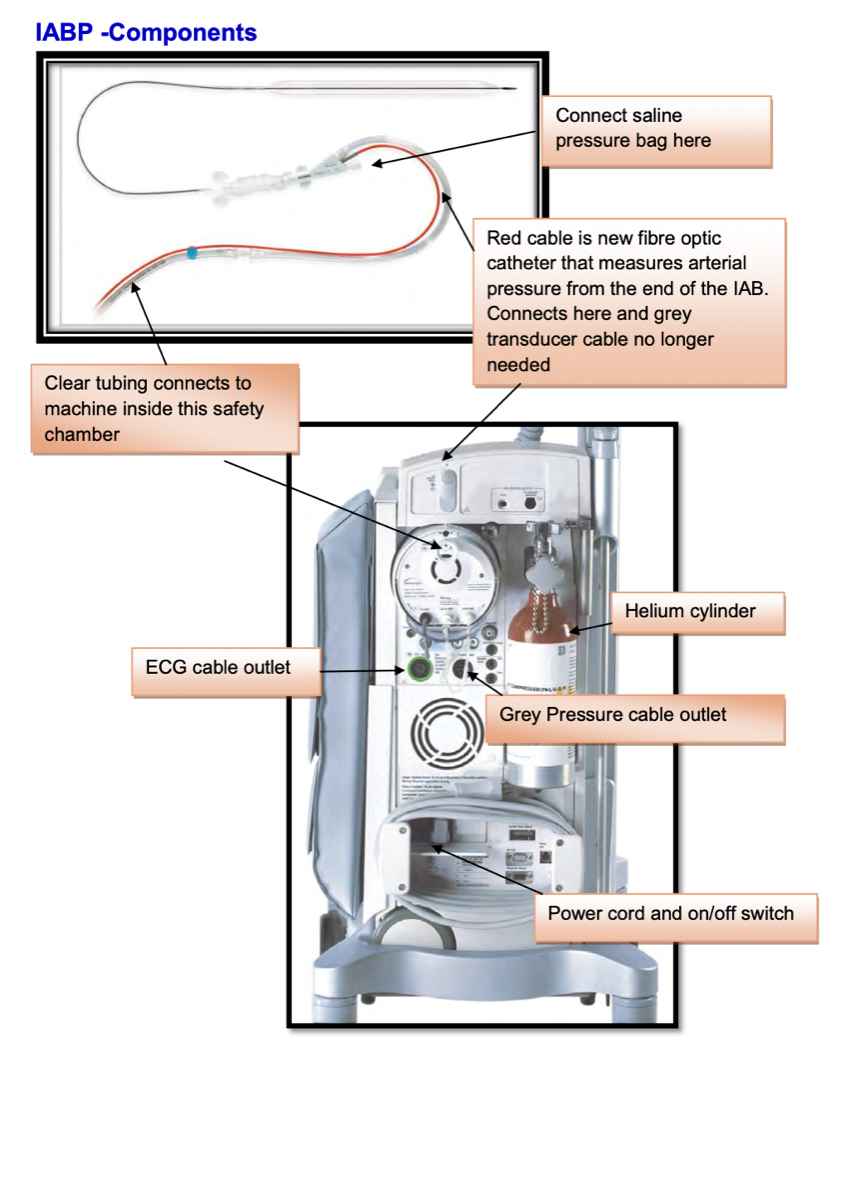
Device Overview
Core Physiology & Hemodynamic Effects

What the Balloon is Doing

  • Sits in proximal descending thoracic aorta, 1-2 cm distal to the left subclavian origin
  • Volume ~25-50 mL depending on patient height
  • Filled with helium (very low density → rapid movement; inert and rapidly absorbed if leak)
  • Inflation in early diastole displaces blood both proximally (toward aortic root/coronaries) and distally (toward visceral and peripheral beds)
  • Deflation just before systole creates a transient 'vacuum' in the aorta → ↓ aortic end-diastolic pressure → ↓ LV afterload and earlier aortic valve opening

Primary Hemodynamic Effects

  • ↑ Diastolic aortic pressure → ↑ coronary perfusion (especially subendocardium)
  • ↓ LV afterload → ↓ LV wall tension and ejection pressure
  • ↓ Duration of isovolumetric contraction (major O₂-consuming phase) → ↓ myocardial O₂ demand
  • Net: modest ↑ stroke volume/cardiac output (often 0.5-1.0 L/min), improved systemic perfusion pressures

Secondary/Systemic Effects (Variable)

  • ↓ Pulmonary capillary wedge/LA pressures (offloading LV)
  • ↓ SVR (functional afterload reduction)
  • ↑ Cerebral and renal perfusion pressures when MAP improves
Benefit depends on: rhythm, native LV function, aortic compliance, balloon volume, and position.
IABP Flow Demonstration
IABP inflation/deflation demonstration showing counterpulsation mechanics
Normal Timing & Waveform Fundamentals

Think in terms of the arterial line – the IABP is just reshaping that waveform.

Key Features of a Normal Assisted Beat

  • Unassisted systolic pressure: the native peak on an unassisted beat
  • Dicrotic notch: marks aortic valve closure — this is your reference for inflation
  • Augmented diastolic peak: tallest peak, appears immediately after the dicrotic notch when balloon inflates
  • Assisted end-diastolic pressure: lowest point just before the next systolic upstroke — should be lower than the unassisted end-diastolic pressure
  • Assisted systolic pressure: systolic peak after deflation — should be slightly lower than unassisted systolic pressure

Rules of Thumb for Correct Timing

  • Inflation: sharp 'V' at the dicrotic notch; augmented diastolic peak immediately after
  • Deflation: trough occurs halfway down the diastolic downslope before the next systolic upstroke
  • Assisted end-diastolic pressure < unassisted end-diastolic pressure
  • Augmented diastolic peak > unassisted systolic peak
Clinical Pearl: Check timing in 1:2 mode so you can compare assisted vs unassisted beats side by side.
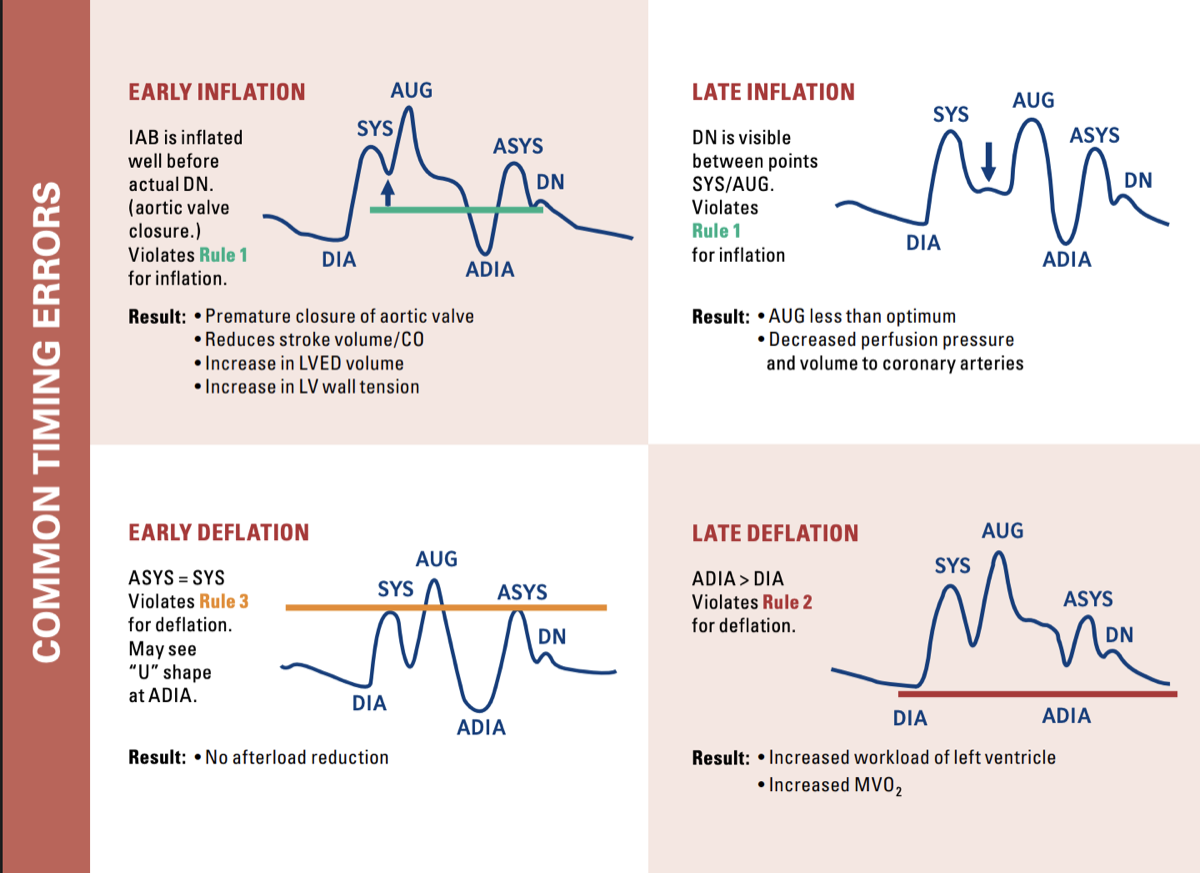
Timing Error Recognition

Classic arterial waveform patterns and what they mean:

Swipe to see more
Error Waveform Clues Physiology What to Adjust
Early Inflation Augmented diastolic peak merges into systolic peak; diastolic 'bump' starts before dicrotic notch; no clear V-notch Balloon inflates while aortic valve still open → premature aortic valve closure, ↑ LVEDV/LVEDP, ↑ afterload, risk of aortic regurg and ↑ MVO₂ Delay inflation (move trigger later) until just at the dicrotic notch
Late Inflation Inflation well after dicrotic notch; augmented diastolic peak small and delayed; augmented diastolic < unassisted systolic Missed chance to push blood into coronaries at onset of diastole → suboptimal coronary perfusion, minimal benefit Advance inflation (move earlier) so balloon inflates exactly at the dicrotic notch
Early Deflation Sharp early drop after augmented diastolic peak; wide U-shaped trough; assisted end-diastolic ≈ or > unassisted end-diastolic; assisted systolic may be higher Lose afterload reduction; aortic pressure returns to baseline before systole, possible retrograde coronary/carotid flow; ↑ MVO₂ Delay deflation slightly (move later) so trough is immediately before systolic upstroke, and lower than unassisted diastolic
Late Deflation (WORST) Augmented diastolic peak looks widened; assisted end-diastolic ≈ unassisted; slow, blunted upstroke of assisted systolic LV begins ejecting against still-inflated balloon → ↑ afterload, prolonged isovolumetric contraction, major ↑ MVO₂; pump can actually impede LV ejection Advance deflation (earlier) so balloon empties before the aortic valve opens
Late deflation is the worst timing error — it actually increases afterload and myocardial work, the opposite of what you want!
Triggers, Modes, and Weaning

Trigger Options

  • ECG (R-wave): preferred trigger; best when QRS is tall/consistent
  • Arterial pressure (AP): useful in atrial fibrillation, paced rhythms, or noisy ECG; uses upstroke of arterial waveform
  • Internal/asynchronous: last resort (e.g., during arrest with no reliable ECG/AP); keeps balloon moving to limit thrombus but does not provide true counterpulsation

Assist Ratios

  • 1:1 — balloon inflates every beat; default for shock and transport; maximal support
  • 1:2 — every second beat assisted; used to check timing and during early weaning
  • 1:3 — minimal support; late weaning step in stable patients

Typical Weaning Approach

(Institutional protocols vary)

  1. Confirm readiness: CI ≥ ~2.2-2.5 L/min/m², MAP ≥ 65 mmHg, no escalating vasoactive support, rhythm stable
  2. Stepwise reduce assist ratio (1:1 → 1:2 → 1:3) while keeping balloon volume unchanged
  3. Reassess hemodynamics, lactate, and perfusion with each step; if MAP, CI, or symptoms worsen, step back up
  4. Only once stable on low assist (e.g., 1:3) do you proceed to removal
Key Point: Never reduce balloon volume during weaning — this increases clot risk. Only reduce frequency (assist ratio).
Indications, Contraindications, and Limitations

Common Real-World Indications

  • Cardiogenic shock after acute MI (especially LV failure with ongoing ischemia)
  • Mechanical complications of MI — acute severe MR (papillary muscle rupture) or VSD as a bridge to surgery
  • Refractory unstable angina/ongoing ischemia despite maximal medical therapy
  • Post-cardiotomy low-output syndrome and difficulty weaning from bypass
  • Bridge to more definitive support (LVAD/ECMO) or to high-risk PCI/CABG in selected patients
  • Refractory ventricular arrhythmias
  • Cardiotoxicity (e.g., verapamil overdose)

Key Contraindications (Absolute/Strong Relative)

  • Severe aortic regurgitation (balloon inflation worsens regurgitant volume)
  • Aortic dissection or significant thoracic/abdominal aortic aneurysm
  • Severe peripheral vascular disease or iliac occlusive disease where catheter would critically reduce flow
  • Uncontrolled bleeding or severe coagulopathy may make insertion/removal unsafe
  • Patent ductus arteriosus
  • Thoracic aortic graft <12 months old

Important Limitations to Remember

  • Requires organized ventricular contraction — minimal benefit in severe LV standstill or VF/VT without perfusing beats
  • Does not directly support RV failure or isolated right-sided cardiogenic shock
  • Effect size is modest compared with ECMO/LVAD — think of it as a 'fine-tuning' device rather than a full replacement pump
  • Benefit is highly dependent on correct timing and rhythm; AF with RVR or frequent ectopy can reduce effectiveness
  • Requires minimum cardiac index of 1.2-1.4 L/min/m² for clinical benefit
  • Heart rate >130 bpm reduces efficiency
Remember: IABP use requires potential for spontaneous recovery or planned corrective intervention. It's a bridge, not a destination.
Bedside & Transport Pearls
  • Always travel with: a charged pump, spare helium tank, and reliable power source; verify battery status before leaving
  • Keep the IABP running whenever possible — a static balloon is a thrombus magnet; if off, manually inflate/deflate per protocol
  • Patient positioning: leg with femoral catheter straight; avoid hip flexion; log-roll rather than sit-up if possible
  • Monitor distal limb perfusion (pulses, Doppler, color, temperature, cap refill) at least hourly or per unit policy
  • Watch urine output and renal function — low output may suggest low flow or balloon too distal (obstructing renal arteries)
  • Secure all tubing and cables; avoid tension on the catheter during transfers and log-rolls
  • Use gentle sedation/analgesia to control anxiety and prevent leg movement while preserving hemodynamics
  • Defibrillation/cardioversion: the pump is isolated/protected, but everyone still needs to be 'clear'
  • In cardiac arrest: consider arterial-triggered or internal-trigger modes to keep the balloon moving during CPR if there is an adequate pressure signal
Transport Tip: Have a plan for defibrillation before leaving the unit. Know your battery life and have backup power ready.
Troubleshooting & Red Flags

Alarms & What They Usually Mean

  • Loss of trigger: check ECG quality, lead placement, cables; if needed, switch to arterial trigger
  • Loss of pressure waveform: check pressure bag, tubing, stopcocks, transducer level/zero, or use an alternate arterial line
  • Gas leak / rapid helium loss: inspect catheter/tubing for kinks or disconnections; look for blood in the helium tubing → suspect balloon rupture → stop pump and notify provider immediately
  • High plateau pressures: may indicate hypertension, reduced aortic compliance, or incorrect balloon volume/position
  • Low plateau pressures: may indicate hypotension, low SVR, or underfilled balloon; correlate with patient and console settings

Clinical Red Flags Requiring Urgent Review

  • Sudden loss of augmentation or major change in waveform shape not explained by timing adjustments
  • Acute limb ischemia: cool, pale, painful leg or loss of pulses on the catheter side
  • New or worsening chest pain, pulmonary edema, or hemodynamic collapse despite the pump
  • Hematuria, rising creatinine, or anuria suggesting renal ischemia
  • Any suspicion of balloon rupture (blood in helium line, unexplained gas loss)

Complications

During use:

  • Limb ischemia (up to 25%)
  • Helium embolism from balloon rupture
  • Hemolysis
  • Thrombocytopenia
  • Peripheral neuropathy
  • Infection

During/after removal:

  • Hematoma
  • Pseudoaneurysm
  • Arteriovenous fistula
  • Catheter entrapment
References
  1. Khan, T. M., & Siddiqui, A. H. (2022). Intra-aortic balloon pump. In StatPearls. StatPearls Publishing. https://www.ncbi.nlm.nih.gov/books/NBK542233/
  2. Nekic, P. (2016). Intra-aortic balloon counterpulsation learning package. Liverpool Hospital ICU.
  3. Yartsev, A. (2015). Intra-aortic balloon pump. Deranged Physiology. https://derangedphysiology.com
  4. IA MED. (2018). IABP timing guide and waveform exercises. IA MED Education.
  5. Nickson, C. (2024). Intra-aortic balloon pump. Life in the Fast Lane. https://litfl.com/intra-aortic-balloon-pump/
Back to Critical Care Corner E3 Learning Home